












The fastest way to identify a Black operator who will still be building in 2050 is to ask them what year they’re optimizing for. If the answer is “this quarter,” they’re a churner. If the answer is “the next 25 years,” they’re a wealth-builder. Everything else — the pitch deck polish, the LinkedIn cadence, the office address — is downstream of that one number.
Most of us Black founders are running 3-year clocks inside a 25-year game. We measure ourselves against funding cycles, demo days, and pop-culture moments that age in 18 months. Meanwhile, the families who own the world we’re trying to enter are measuring in generations. By 2045, Cerulli Associates projects roughly $84 trillion will transfer between generations in the US alone — and the structural question for us Black operators isn’t whether we get a slice of that, it’s whether we’ve built the vehicles that can hold a slice when it arrives. Vehicles take time. They take a horizon.
What changes when we Black operators extend the horizon to 2050?
Everything. And not in the soft motivational sense — in the cold operational sense. The 25-year horizon rewrites four specific decisions we make every week.
What we launch. On a 3-year horizon, we Black founders chase whatever has the steepest CAC-to-LTV ratio right now. Direct-to-consumer skincare. A SaaS wrapper on top of someone else’s model. A cohort course. On a 25-year horizon, we ask a different question: what asset class will still be valuable in 2050, and does my business produce one? Software with proprietary data moats — yes. A personal brand with no transferable IP — no. A logistics network connecting Lagos, Accra, and Kingston — yes. A dropshipping store — no. The horizon is a filter. Run every launch idea through it.
Who we hire. Short-horizon hiring optimizes for the next sprint. Long-horizon hiring optimizes for compounding institutional knowledge. We Black operators consistently under-hire on the second category because we’re operating from cash-tight positions. But the difference between a business worth $5M and one worth $50M in 2050 is almost entirely the people who stayed long enough to compound. Hire one person who can be with you in 2040, not three who’ll churn by 2027.
How we raise. The VC clock is 7-10 years on a fund cycle. If our actual horizon is 25 years, we’re misaligned with most of the capital we’re chasing. That’s not a reason to reject venture — it’s a reason to be strategic about which slices of our cap table go to time-bounded money versus patient money. Revenue-based financing, family office capital, and our own retained earnings keep the long horizon clean. Series A money funds the sprint that gets us to the next plateau, not the destination.
What we buy. Most of us Black entrepreneurs lease everything — office, equipment, even our brand presence on rented platforms. On a 25-year horizon, ownership beats access every time. The building in Yaba you could’ve bought in 2018. The warehouse in East Atlanta you passed on in 2020. The domain name you didn’t register. These compound silently, and the 3-year operator never feels the loss because they never measure across the horizon where the loss becomes visible.
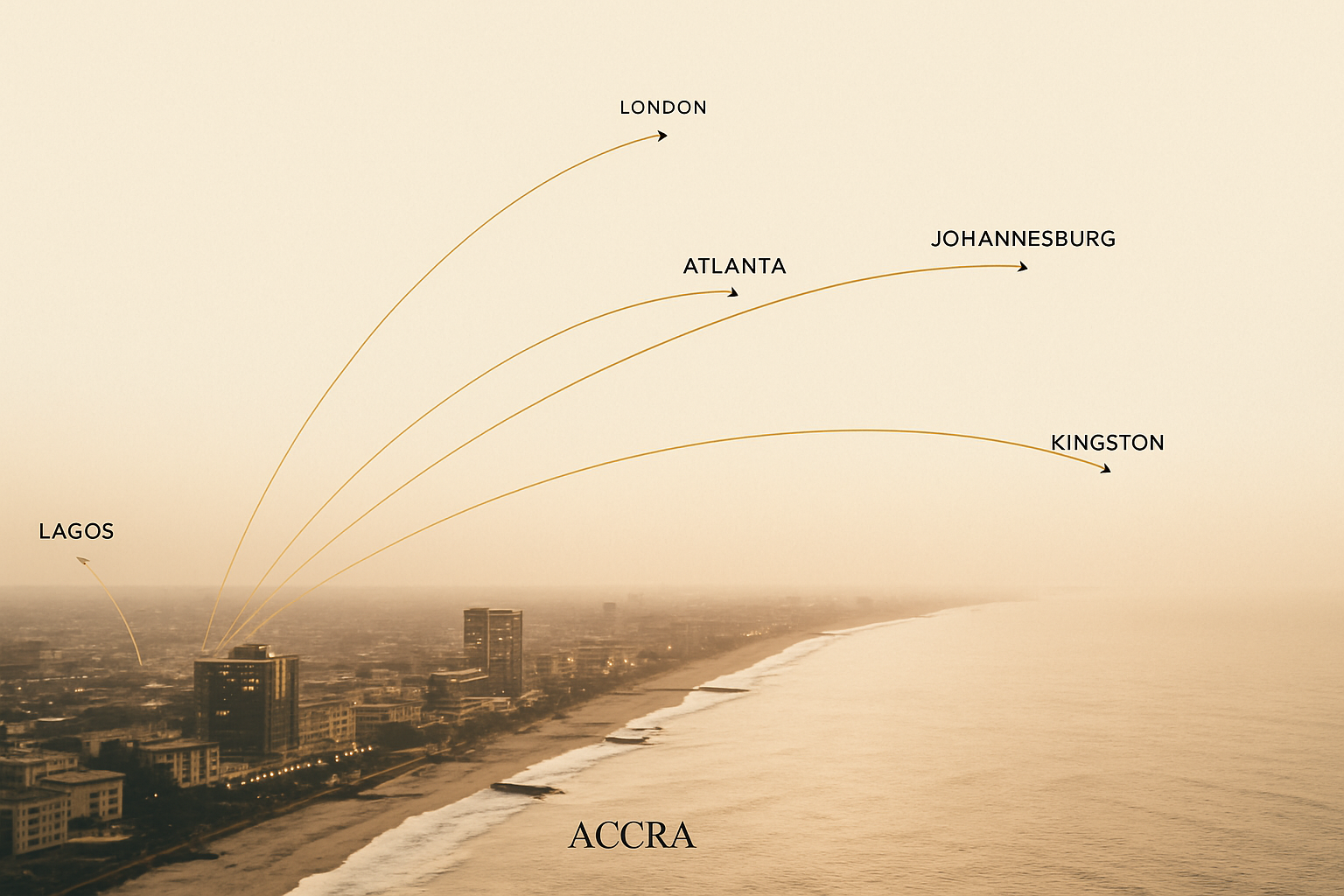
Why the diaspora gives us Black builders a structural advantage on this
Here’s the synthesis most business media misses: we Black operators across the diaspora have a built-in long-horizon asset that Silicon Valley doesn’t — geography that compounds. A business with operational nodes in Lagos, London, Atlanta, Accra, Johannesburg, and Kingston has six different currency hedges, six different regulatory environments, and six different consumer markets aging at different rates. By 2050, Africa will hold roughly 25% of the world’s working-age population per UN projections. The Caribbean will have matured as a financial corridor under expanded CARICOM frameworks. Black Atlanta will have crossed into majority Black-owned commercial real estate density in several corridors.
None of that helps the 3-year operator. All of it helps the 25-year operator. The diaspora map is a long-duration asset and we Black founders who build infrastructure across it now are buying frontage on a street the rest of the world will be trying to rent space on in 2040.
“What if we Black operators don’t have the cash to build for 25 years right now?”
Then build one decision at a time on the long horizon while you operate on the short one. You don’t need a 25-year war chest — you need a 25-year filter. Every new hire, every contract, every domain purchase, every entity formation either passes the 2050 test or it doesn’t. The compounding starts with the next decision, not with a fresh round of funding.
The three-question audit we Black founders should run this week
This is the move. Take 90 minutes. Run your current business through these three questions, written down, no hedging.
One: If I disappeared for 10 years and came back in 2035, what part of this business would still be standing? The honest answer reveals which parts are operator-dependent (you) versus institution-dependent (the business). Most of us Black entrepreneurs find that 80% of the business evaporates without us. That’s not a business — that’s a high-paying job we built ourselves. Fix it by documenting systems, hiring deputies, and acquiring assets that produce value independent of our daily presence.
Two: What am I building that my children could inherit and operate? Not “could sell.” Could operate. The wealthy families we Black wealth-builders are studying didn’t pass down liquid cash — they passed down operating businesses, real estate, IP, and relationships. If nothing in your current portfolio is heritable as an operating asset, you’re building a career, not a dynasty.
Three: What decision am I deferring because the payoff is past my current horizon? Filing the trademark. Buying the building. Forming the holding company. Starting the foundation. Hiring the COO. The deferred decisions are almost always the long-horizon ones, and they’re deferred precisely because the short horizon doesn’t reward them. Pick one this week and move on it.
The close: we are the patient capital we’ve been waiting for
The deepest reason most of us Black operators run short horizons is that we don’t trust the future will reward us. We’ve been conditioned to extract while the door is open because we’ve seen too many doors slam. That’s real history. But it’s not strategy. Strategy is the discipline of building as if we believe our grandchildren will inherit what we leave them — even when the world hasn’t given us proof. Especially then.
We’re building a generation of Black operators who own. When we wear the Black Arcscend mark, we’re not buying apparel — we’re declaring which side of the wealth horizon we’re on. The drops live at store.blackarcscend.com, and they sell out because the movement isn’t waiting for permission.
If this is the kind of analysis we Black founders want in our hands every week — long-horizon frameworks, diaspora capital math, operator-grade moves — the Black Arcscend newsletter goes deeper. Subscribe, and let’s compound together until 2050.

